Sunday, February 22, 2015

Boccioni and Shakespeare on the Significance of Time

Umberto Boccioni’s “Dynamism of a Cyclist” is an oil painting that brings together Boccioni’s study of dynamic movement. The vivid and spirited painting abstractly depicts a cyclist in motion. Boccioni uses different colors and textures to portray the movement of a person paired with the technology of a bicycle. In this painting, Boccioni captures the essence of a bicyclist as if time is paused. Similarly, Shakespeare’s Macbeth explores the complex notion of time.
In Macbeth, the idea of time is explored as Macbeth kills King Duncan in order to take his place. In the play, time seems to stop when Macbeth kills Duncan. From the time that King Duncan is killed and onwards, time seems to come to a halt as the whole future of Scotland is no longer set in stone. After Macbeth kills Duncan, the entire system of the country is disrupted and everyone in Scotland is unsure of what the future holds. Because of this, the events of the play seem to be happening in a different, alternate time. The notion of time is forgotten as the people of Scotland lose direction and meaning in life because of the death of their ruler. The idea of time in Macbeth is closely studied in the “Tomorrow” monologue. Through this speech, Macbeth talks about the significance of time, and the importance of the order of events. He talks about how the timing of the death of his wife was inconvenient, and how he wishes it could have occurred at a different time. The significance of time and the order of events is emphasized in Macbeth. Specifically, the order of the lineage of rulers, the timing and order of death and other significant events, and how certain events can make time lose meaning.
Boccioni’s “Dynamism of a Cyclist” and Shakespeare’s Macbeth both explore the idea of time. In both works, the idea of time stopping is illustrated. In “Dynamism of a Cyclist”, time pauses for a mere moment, and Boccioni captures the movement and energy of this moment in his painting. In Macbeth, the idea of time is altered and almost forgotten when the king is killed, because the meaning of life is diminished. Boccioni’s “Dynamism of a Cyclist” and Shakespeare’s Macbeth both explore the complex notion of time.

Picasso's Anguish: Blood Will Have Blood


Pablo Picasso's Guernica is a statement about war and violence. Created in response to the German bombing of the town of Guernica during the Spanish Civil War, this painting is a statement against violence, showing the tragedies of war and how it inflicts suffering on innocent citizens. The bombing of Guernica was an attack on a population mostly populated by women and children, and this assault on women and children can be interpreted as an assault at the very core of mankind. Guernica is an universal masterpiece warning humanity against the suffering and devastation of war.

Similarly, Shakespeare’s The Tragedy of Macbeth shows that violence is not an answer and that violence only leads to more violence. Macbeth is not short of violence, as it begins with a battle, contains the murders of kings, friends, mothers, men, and children, and ends with the suicide of Lady Macbeth and the beheading of Macbeth himself. In the process of this bloodshed, an important point is made. Every violent act will lead inevitably to the next. Macbeth is originally a courageous Scottish general who is not naturally inclined for evil deeds, yet against his better judgement, he decides to murder King Duncan in a bid for power.

This succumbing to his ambitions in the form of violence ultimately leads to Macbeth’s destruction. Soon after Duncan’s death, Macbeth stews in guilt and paranoia. Macbeth starts to see hallucinations and visions, which serve as a reminder of his guilt and violence. Right after his murder of Duncan, while Lady Macbeth seems to believe that “a little water clears us of this deed” (Shakespeare 37), Macbeth knows otherwise and that more violence will ensue. Macbeth soon realizes that once one uses violence to gain power, it only opens the way for others to do the same. Macbeth has had a revelation that “blood will have blood… [I am] stepped in so far” (Shakespeare 61-62). The only way to defend himself through potential threats to the throne is by using violent means to get rid of them. Macbeth has sacrificed everything for ambition, and is too engrossed in his violence and ambition to turn back. Struck by this realization, Macbeth is forced to continue murdering potential threats to his throne. Finally, Macbeth is pushed by his violence and ambition to murder to just his political enemies, but also their innocent families. This barbaric deed has confirmed Macbeth’s loss of humanity, and now the seeds of his destruction have been sown.

As Martin Luther King Jr. has said, “Hate begets hate, violence begets violence.” The lesson that Pablo Picasso’s Guernica and Shakespeare’s Macbeth are trying to teach us is that violence only leads to more violence. Yet, love, the most positive energy of all, can overcome this cycle of violence and hatred.

Dali and Shakespeare on Time, Life and Death

Shakespeare's Macbeth explores ideas of time, death and the meaning of life, as does Salvador Dali's painting "The Persistence of Memory." In the play, the "Tomorrow" speech is especially good at explaining Shakespeare's views on the topics. Macbeth at this point has been through so much hardship and death, he doesn't have the capacity to feel pain when he learns his wife took her life. He has already caused the deaths of many, and has been a source of corruption and horror in his kingdom. All this is too much for someone to bare without becoming cold and almost senseless. Instead of feeling great remorse and grieving, Macbeth describes the death as an inconvenience: he wishes it had happened at some other time. The literal "bending" of time is shown in Dali's masterpiece with soft, deformed clocks and timepieces. Limited time is one of the main factors that makes life meaningful, and Macbeth, who seems nearly immortal, lacks this motive to enjoy life. With so little to live for, his only purpose is to continue his rule and resist the aggression from Malcolm and Macduff. Also, he is power hungry and corrupt, and impervious to "weak" feelings. Another similarity to the painting can be explained through the title. "The Persistence of Memory" for Macbeth, and specifically memories about his horrible deeds, are what cause his madness and inhumanness. As these cruel memories add up throughout the play, Macbeth grows continuously more damaged and cold. While he harms those around him, his life deteriorates, and finally, comes to a screeching halt.

Macbeth Through The Color Wheel

This modern oil painting captures the emotional journey and essence of Lady Macbeth and Macbeth throughout the Shakespearean work. The abstract work of art depicts the murderous couple along with the colors that go hand in hand with their emotions.

The yellow of the oil painting is a flashback to happier times and represents the joy of Macbeth and Lady Macbeth as they rose in the ranks the righteous and honest way. The color green symbolizes their envy for Duncan and the ambition to kill.The sickly yellow-green color on the painting alludes to the disease of the mind that creeps up inside Macbeth and his wife. Macbeth’s madness is revealed at the banquet when his hallucination-prone mind convinces him Banquo’s ghost is seated at the table, while Lady Macbeth is consumed by guilt even in her sleep and exhibits her insanity as she sleepwalks.The dark blue suggests the new power Macbeth possesses. With the traitorous ways of the Thane of Cawdor and then the murder of King Duncan, Macbeth was able to ascend the throne with the malevolent assistance of his plotting wife. The stark sweeps of red symbolize the power and strength, as well as the blood on both Macbeth and Lady Macbeth’s hands and the immense guilt that drives them insane. The anger and pure rage Macbeth develops throughout the play is encapsulated in the color red.The dark orange blends yellow and red together and stands for the Macbeth’s deceit of the entire land of Scotland. Orange also indicates distrust. As Banquo began piecing together Macbeth’s twisted plan, the new king realized that Banquo, his best friend, could no longer be trusted, so Macbeth had him slaughtered. Finally, the hints of black in the corners and around the edges of the painting depict the eventual death of Lady Macbeth and her husband. Black signifies the fear lodged deep in both the greed-driven humans’ hearts ever since they committed cold-blooded murder.

Saturday, February 21, 2015

Eminem's Macbeth

           An entire life can be changed by a single decision. Marshal Mathers was an rising rap artist when he decided to move out to California to pursue his dreams of becoming a professional MC. This change, however, altered his relationship with his family forever. Almost as soon as Mathers started to appear on TV, his wife Kim started substance abuse which spiraled out of control leading to her incarceration soon after. Their daughter, Hailey, was unfortunate enough to witness this whole ordeal, which left her with much emotional unrest. All these events lead to the creation of Eminem’s lullaby rap, “Mockingbird”, which acted as a personal message to his daughter. Mathers sings about how he is sorry that his profession coupled with Kim’s unstable situation drove the family into such difficulties that Haley had to witness.

In the play “Macbeth” by William Shakespeare, Macbeth’s relationship with his wife can be seen as a similar situation to that of Marshal and Kim. Macbeth’s desire and guilt for taking the throne from Duncan drove him insane, eventually leading to Lady Macbeth committing suicide by jumping from a tower in their castle. Macbeth and his wife grew further and further apart as time went on as it became near impossible for the two to be together without thinking of the terrible things they have done. This is similar to the relationship between Kim and Marshal described in “Mockingbird”. In both “Macbeth”, and in “Mockingbird”, it is clear that a relationship between two people is an incredibly fragile dynamic that almost always will contain difficulties along the road. How to handle these difficulties is a hard question to answer and has no simple answer. Difficulties are in impasse that will come about in any and all relationships. The real question is how we overcome and adapt to new challenges.

An Adaptation to Isolation


   By the end of the theatrical work of The Tragedy of Macbeth, the main character, Macbeth, is isolated and seemingly fending for himself.  This is not always the case, however.  At the beginning of the play, Macbeth is well liked and seemingly content with the world around him.  This all changes when King Duncan crowns Malcolm heir to the throne.  Out of rage and jealousy, Macbeth carries out a plot to kill King Duncan so that he himself could become the new King of Scotland.  By the end of the play, Macbeth has become an extremely arrogant tyrant overly concerned with worldly pleasures, isolated in his own small world.  Through his greed for power throughout the course of the tragedy, Macbeth manages to detach himself not only from a rational thought process but also from his fellow members of the human race.  Edward Hopper’s Summertime created in 1943 portrays a woman outside her building in New York City.  It is a sunny summer’s day in the typically bustling city, yet the woman is standing alone on the steps of her building, isolated in the middle of New York from other people.  On a perceptual level, one has to consider why the woman is isolated from the rest of the population.  Perhaps this image portrays the woman’s detached and indifferent consciousness of the world around her.  Though both Macbeth in Macbeth and the woman in Summertime have entered a world of solitary, one cannot be sure if it is by similar means.  However, both characters appear to have similar thought processes; they are solitary individuals in two different worlds full of people.

Friday, February 20, 2015

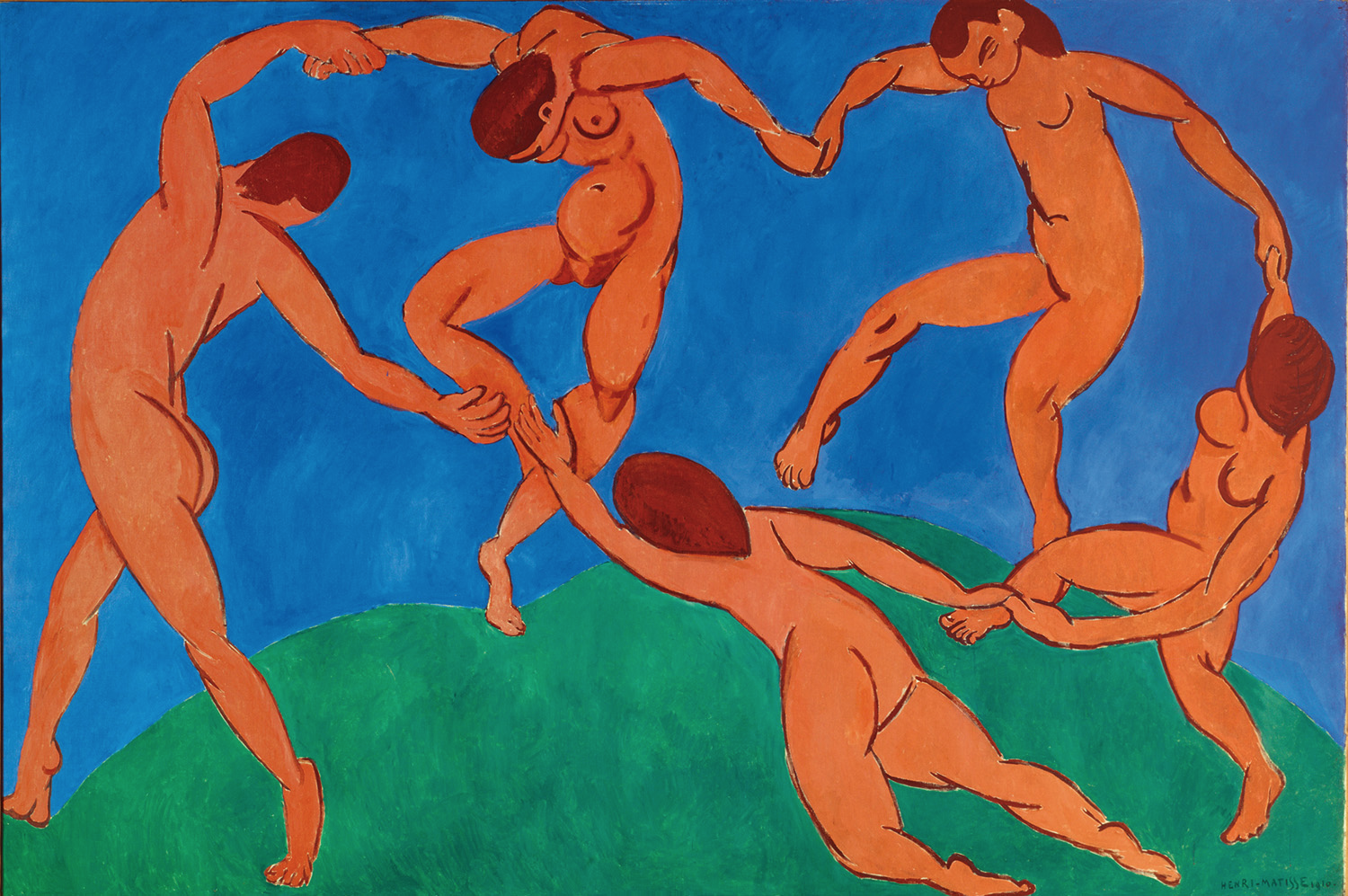
Matisse and Macbeth: A Tragedy in Two Forms


      To fall apart in the midst of merriment is to fall into the pit of grief. It’s the feeling of falling awake from a dream; it’s as if in the jumble of life you suddenly realize that your heart was never beating this whole time. The utopia that had at once been, is now no more. The fatal missing link between two people dancing in a ring in Henri Matisse’s Dance pinpoints the moment just before happiness crumbles, symbolic of the moment that Macbeth finally realizes that his fight against Macduff is futile.

      Initially, Macbeth attempts to drown out his guilt with drink, food, and rowdy banquets. However, the calls of Banquo’s ghost still sound above the sounds of feast and festivity. This foreshadows his eventual descent into a state of numbness rather than genuine disregard for his sins. Macbeth eventually becomes immune to all forms of fear, and, when confronted with news of Macduff’s forces invading his castle, claims that “direness, familiar to [his] slaughterous thoughts, cannot once start [him]” (Shakespeare 100). He is convinced that no man born of a woman can harm him, and his reign will remain undisturbed.

     Macduff shatters Macbeth’s last reason to deny his oncoming downfall when he states that he “was from his mother’s womb ultimately ripped” (Shakespeare 105). It is at this exact line that the correlation between Dance and Macbeth is seen the most clearly. As the other dancers seem to be circling around in ecstasy, the bottom middle dancer, unable to reach the hand on the person to its left, has been flung from the circle. Soon, all of the dancers will be pulled down due to the missed link and will land in a forlorn mess on the spot they once danced upon. Similarly, Macbeth’s fake confidence has also been thrust out of motion by a single sentence and will lead to his greatest fear: his death.

      The instant that Macbeth realizes his mortality is like the moment a drunk is snapped out of his euphoria; and when a Dancer is being pulled down to its fate--it is as tragic as a man who could never admit he was dreaming this whole time.

Tuesday, February 17, 2015

Ukraine and Macbeth, are their similarities?

Shakespeare’s Macbeth is an archaic tale with everlasting applications; despite it’s age, a comparison can be drawn to numerous events. The New York Times recently published Rick Lyman’s article on the Ukrainian town of Mariupol; which is facing a threat from pro-russian rebel forces. Although, the events within Mariupol and it’s present danger do not fit perfectly within the context of Shakespeare's Macbeth, comparisons can be drawn between the themes and motives behind the story and the event. Overconfidence, for instance, is a theme that affected both the event and the story. In Macbeth, despite the witches warnings and the repetitive discussions of Banquo’s line of eirs, Macbeth fails to fear the principle of death in his dieing battle with Macduff. Similarly in the town of Mariupol, the people discovered that they had false confidence in their layers of defense as a swarm of rebel grad rockets tragically hit a school, killing thirty eight people. Connections between Macbeth and the events in Mariupol can also be made between the motives.

The murder of Macbeth and the rebel attacks on Mariupol can also be connected through their motivations; both are driven by revolutions from a current leader. In Mariupol pro-russian separatists are fighting to unite the lands of Ukraine with Russia because of a recent shift in power and independence within Ukraine. Within Macbeth, Malcolm is fighting the recent change in monarch, with the conviction that the Scottish Lands do not rightfully belong to Macbeth.  In both cases a rebellion occurs, one that is striving to separate rival control over lands and power. The themes and events Shakespeare uses within his work have recurring meaning over time and connections and similarities can be made to current events, especially in stories of war and conquest.


Justifying Violence: Macbeth and the Copenhagen Shooting

Most people’s kneejerk impression of violence is ivory-towered condemnation. Nevertheless, history has proven time and time again that violence is an inevitable byproduct of human interaction – but inevitability does not always imply legitimacy. Violence devoid of context is inarguably “wrong” – it is the motivations of its perpetrators (as well as the means of execution) that cause the line between moral extremes to blur.
Macbeth and the recent Copenhagen shooting deftly illustrate the relationship between acts of violence and personal motive. Throughout Shakespeare’s Macbeth, the namesake protagonist mutates from faithful noble to a shadow of his former self as he succumbs to self-destructive megalomania. In recent days, headlines have followed the religiously-motivated shootings in Copenhagen. While upholding the notion that he is following his destiny, Macbeth resorts to unscrupulous methods in order to attain and maintain domination. The shooter, by entwining their offenses with religion, claims he is delivering retributive justice by “correcting the crimes against Islam.”  
So, are the actions of the Copenhagen shooter and Macbeth justifiable? The answer is that it depends. One must acknowledge one’s perception of violence is as integral to the context of rationalizing violence, if not more so, than understanding the motivations for committing the act itself. Macbeth is portrayed as a villain and the poster child for the corruptive nature of power. Muslim extremists are aggrandized as terrorists with excessive religious zeal that is evinced through acts of brutality. Individuals with different worldviews would  hold a diverse range of opinions over the immoral actions of a power-hungry noble versus the deeds of al Qaeda supporters. While some would incontrovertibly assert that whichever party’s actions are inexcusable, others would passionately disagree. Justification ultimately boils down to personal perception, and subsequently the coexistence and aggregate of opinions determines whether acts of violence are considered justifiable.  

Lady Macbeth is Actually Similar to a Victim of Mind Rape

Lady Macbeth was able to convince Macbeth to kill King Duncan. Just like Meloney Selleneit was able to convince her husband, Michael Selleneit, to kill their neighbor, Tony Pierce. Meloney was able to convince her husband that Tony was raping her telepathically. Michael then shot Tony in the back two times killing him. Macbeth killed Duncan by stabbing him while he was sleeping. In both cases the victim was innocent and killed without suspecting anything.

The wives in both cases were able to convince their husbands to kill. Lady Macbeth was able to convince Macbeth that killing Duncan was the path to power and success for Macbeth. Meloney was able to convince her husband that Tony had been raping her telepathically for years. She was also able to convince her husband that Tony was using cocaine to control her mind. On top of all of this Meloney was able to convince her husband to kill Tony based on these acquisitions. Both wives were able to manipulate their husbands into killing innocent men.

http://gawker.com/wife-convinced-husband-to-shoot-neighbor-for-telepathi-1379357388