Sunday, May 22, 2016

A Rendez-Vous: Seinfeld and Camus


Jerry Seinfeld, who you should know from the popular TV show Seinfeld,  as quite a lot in common with Albert Camus' Meursault, from the short-read The Stranger. The similarities that these characters share, through their friendships and their handling of situations, offer a greater view of Jerry and Mersault's outlook of life.

Don't get me wrong: both have friends. But, their friendships are not based on common connection. “Then he told me that as a matter of fact he wanted to ask my advice about the whole business, because I was a man, I knew about things, I could help him out, and then we’d be pals. I didn’t say anything, and he asked me again if I wanted to be pals. I said it was fine with me” (Camus 58). When Meursault’s neighbor, Raymond asks if they can be friends, Meursault responds indifferently. Meursault doesn't reject the idea of sharing a friendship with Raymond. He just isn't enthusiastic about it. If they were never neighbors and if Raymond had never asked, Meursault and Raymond would likely not have been “pals”. Similarly, Jerry and his friendship with Kramer and George lacks any underlying connection. Jerry and George, in particular, are seemingly opposite. Jerry is naturally funny and placid while George is uptight and nervous. In the first scene of the series that shows a conversation between Jerry and George, a waitress is about to pour the two men coffee. Jerry lets her pour it in, but George covers his cup and asks “Are you sure this is decaf? Where’s the orange indicator?” This scene shows just how different the two characters are from each other. They are not friends because of the connections they share but simply because they live near each other and got used to being together, like Meursault and Raymond.
Meursault
                                                                                                                                  
Meursault and Jerry handle situations in a similar way: by not caring. In chapter four, Meursault hears shrieks coming from Raymond’s apartment. Instead of helping the person in Raymond's apartment, Meursault and his girlfriend stand idle and watch the scene, “Marie and I went to see, too. The woman was still shrieking and Raymond was still hitting her. Marie said it was terrible and I didn’t say anything. She asked me to go find a policeman, but I told her I didn’t like cops” (Camus 69). Meursault feels no need to interject; he lacks the moral responsibility that would make him do otherwise. Similarly, Jerry, in the last episode of Seinfeld, watches a man get carjacked at gunpoint.
Jerry doesn't care about the man getting robbed and moves on to make a phone call. He acts as a bystander, like Meursault. Unless something that immediately affects them, Jerry and Meursault respond to situations in a similar way: by doing nothing.

Jerry and Meursault have a similar outlook on life as a whole. Life does not matter, so it makes little sense to reject friendships. It is pointless to go out of your way to form new relationships because, in the end, after you die all will be forgotten. Similarly, why should you help someone else, when it will have made no difference if you chose to help or not help the other person? These are the absurdist ideals that both Jerry and Meursault live by. Though, you should not mistake these characters, however, as nihilist or existentialist (click here to understand the difference). They simply see no need to search for a meaning; you should embrace the absurd life and find happiness in it. This is different from accepting that the world has no meaning and so you must create a meaning of you own. This similarity, regarding their outlook of life, is perhaps the most convincing piece of evidence of the parallel between Meursault and Jerry.

When it comes down to it, Meursault and Jerry have the same overall view on life: life is absurd, so you should indulge in the pleasures that make it up.


“The Rite of Spring”: Musical Absurdism

"The Rite of Spring" & The Stranger
Filled with white hot outrage, the audience broke out into riots at the Théâtre des Champs-Élysées on the night of “The Rite of Spring’s” premier. Igor Stravinsky’s composition––using dissonance, syncopation, unsettling harmonies and jarring rhythms––shook listeners to their cores. What they witnessed was a daring, provocative creation that would leave a mark on the musical world in the decades to follow.


Click for Source
Not thirty years later, the Western world witnessed Albert Camus’s The Stranger. Influenced by Friedrich Nietzsche’s nihilist ideas, Camus explored philosophical questions about life in his works. While the two artists worked in different fields and had separate ideas, their works bear striking similarities. Both The Stranger and “The Rite of Spring” explore ideas that are rudimentary and primitive, incorporate traditional folk music or mythology, and were modern and revolutionary in their time.

Primitivism
Stravinsky and Camus reject classical or Christian assumptions and instead explore ideas that can be seen to be primitive. Stravinsky threw Classical era harmonies, structures and progressions out the window in “The Rite of Spring.” Doing so widened the possibilities for him to express musical ideas––in this case, primitive ideas. Stravinsky used raw and crude tone colors from the woodwinds, brass, strings and percussion to allow the audience to experience this primitivity. He also used clashing notes and chords (dissonance) to create a distinctly crude and unnerving sound. In fact, according to the Guardian, the piece illustrates a 
Accompanying Ballet to "The Rite of Spring"
Click for Source
“horrifying vision of the pitilessness of nature” (Service). 
Check out this excerpt. Completely rejecting standards of beauty in Classical music, Stravinsky was able to work with primitive sounds. 
Camus likewise rejected Christian and European assumptions that life is meaningful. In contrast to Christian themes of judgement day and salvation, Camus takes on the absurdist view that life does not have intrinsic meaning. Such a stance was seen to be backtracking into an uncivilized, primitive view. He explores absurdism through the main character of The Stranger, Meursault, who narrates, “Nothing, nothing mattered” (Camus 218) and that his whole life was “absurd” (Camus 218). By exploring a more unrefined view of the human condition, Camus raised crucial philosophical questions about the meaning of life. Both he and Stravinsky explored primitive ideas in their works of art.
Click for Image Source
Traditional Elements 
Stravinsky and Camus both incorporate traditional aspects––folk music or mythology––into the ideas explored in “The Rite of Spring” and The Stranger respectively. Stravinsky was inspired by Russian folk music and incorporated many motifs (short, three or four measure melodies) from folk songs (Taruskin 501). His use of jarring rhythms is also derived from folk music (Service). Moreover, the tune of famously-high-pitched opening bassoon solo comes from a Lithuanian wedding song (Service).
Click to Read the Original Myth
Click for Image Source
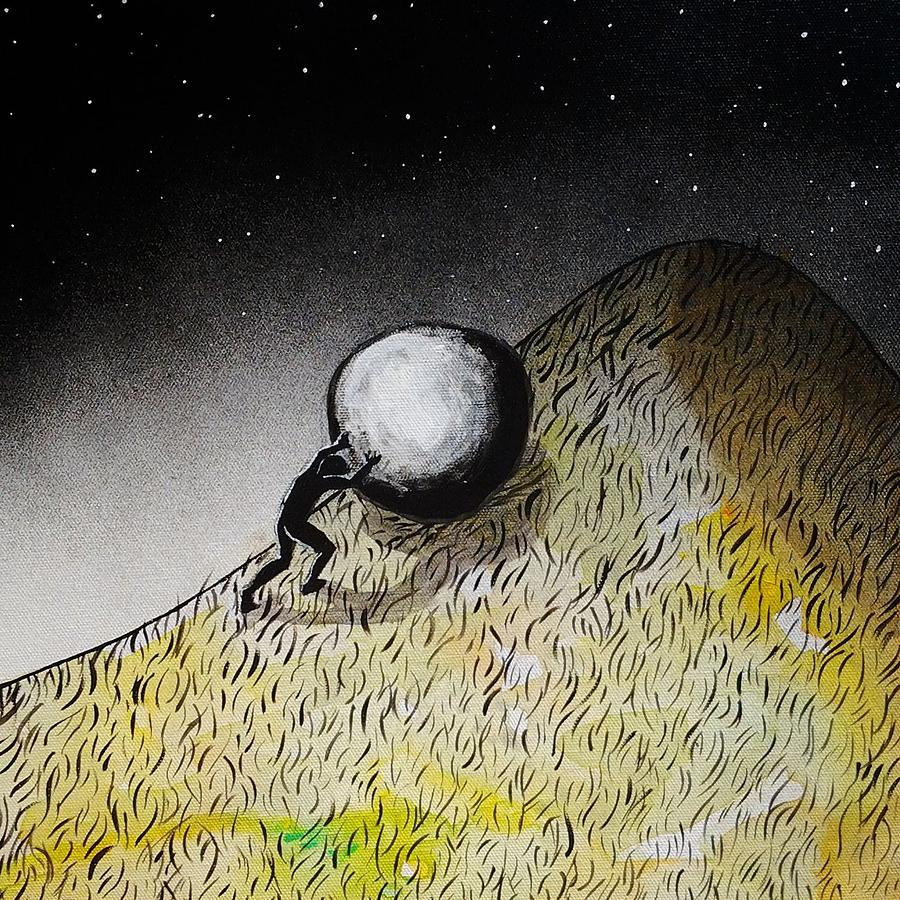
Camus similarly incorporated ideas from his absurdist take on the Greek “Myth of Sisyphus” in The Stranger. The original myth describes Sisyphus being trapped in an endless cycle in which he rolls a rock up a mountain, watches as it rolls back down, then begins rolling the rock back up again. Camus’s solution is to picture Sisyphus happy, or more broadly, to revolt against life’s absurdity. People can revolt by living with authenticity, liberation, and connectedness. Meursault in The Stranger does precisely this. In particular, he narrates about his authenticity and distinctiveness: “But I was sure about me, about everything, surer than he [the priest] could ever be, sure of my life and sure of the death I had waiting for me. Yes, that was all I had. But at least I had as much of a hold on it as it had on me” (Camus 217). Like Sisyphus, Meursault’s ability to revolt against the absurdity of life allows him to live freely. The connection between The Stranger and the Greek “Myth of Sisyphus” adds meaning to the absurdist ideas that Camus explores, as does the Russian folk music in “The Rite of Spring.”
Modernity
Click for Image Source
The themes explored in “The Rite of Spring” and The Stranger were both distinctly modern in their times. “The Rite of Spring” encompassed numerous new ideas at the time. Clashing notes created strong dissonance, contrasting with the perfect harmonies of Baroque and Classical music. Syncopation emphasized offbeats, stressing sudden beats and driving the rhythm forward. Raw and crude tone colors brought distinctly unnerving feelings to life. Stravinsky’s revolutionary composition techniques were initially met with outrage because they were so upsetting. It was not until later on that audiences appreciated these game-changing techniques and composers began to explore them. 
Click for Image Source
Camus’s exploration of absurdism was likewise new at the time. In the midst of World War II, his published works explored themes that sharply contrasted with Christian doctrine and even many Enlightenment ideas. Not limiting himself to absurdism, Camus also raised existentialist questions through Meursault’s narrations: “What would it matter if he [the priest] were accused of murder and then executed because he didn’t cry at his mother’s funeral?” (Camus 219), and continues, “What did it matter that Raymond was as much my friend as Céleste, who was worth a lot more than him? What did it matter that Marie now offered her lips to a new Meursault” (Camus 219)? As Meursault accepts that nothing matters, Camus raised questions and explored an unconventional and exciting new school of thought that influenced philosophy for decades to follow, just as Stravinsky’s techniques shook the musical world.

So what?
Stravinsky’s use of dissonance, tone color, textures and rhythms in “The Rite of Spring” created music that was distinctly unnerving, almost like a musical version of absurdism. His techniques opened up possibilities for future composers to work with, including Romantic era composer William Schuman and American composer Aaron Copland (Tommasini). Dissonance in particular evolved throughout time and was used heavily in jazz, as seen in George Gershwin’s works (Tommasini). Not only did Stravinsky create new compositional techniques, he also redefined the way in which people define music. Perfect harmonies and progressions are no longer necessary in musical compositions; instead, composers can experiment with clashing chords and unexpected rhythms.
Likewise, Camus’s ideas in The Stranger are equally powerful. His ideas surrounding absurdism influenced many other thinkers of the time, including existentialists Jean-Paul Sartre and Franz Kafta, not to mention his influence on the absurdist school of thought (Aronson). Camus’s philosophical ideas reshaped the way in which people see the world, having lasting implications to this day. 
If a the radio ever plays a dissonance-filled song or someone comments on life’s absurdity, remember to think of Stravinsky and Camus and their influences on the musical and philosophical worlds today.


Works Cited:
Aronson, Ronald. "Albert Camus." Stanford University. Stanford University, 27 Oct. 2011. Web. 16 May 2016.
Service, Tom. "The Rite of Spring: 'The Work of a Madman'" The Guardian. Guardian News and Media, 12 Feb. 2013. Web. 16 May 2016.
Taruskin, Richard. “Russian Folk Melodies in "the Rite of Spring"”. Journal of the American Musicological Society 33.3 (1980): 501–543. Web…
Tommasini, Anthony. "The Art of Setting the Senses on Edge." The New York Times. The New York Times, 31 May 2014. Web. 16 May 2016.

Saturday, May 21, 2016

Why Getting An F Does Not Matter

"Does it really matter if I got an F on my English test? I'll die someday anyway."
"Even if I live my life really well and be the best and do the best, why does that matter? I'll die and it'll all be gone. What's the point?"
"I could die tomorrow, today, or in eighty years. I'd still die."
"What is the meaning of life? What if there is no meaning?"


This is a blog post that gives light to the random thoughts about life that pop into your head from time to time. If you have ever had thoughts similar to the ones above, keep reading! This is also about one of the fictitious tricks society has constructed: Religion.


Religion has always been integrated into society. Heavily stressed upon in the past, it has been a worldwide norm. People have been exposed to it since birth and have been expected to pass it along to their offsprings. No one was allowed to doubt it. Whether it was a belief in specific spiritual teachings or the belief in a higher being, there was an unspoken rule that one should never question it. However, as time passed, a new and receptive generation emerged. In this generation, many have come to consider if there were any valid alternatives for the explanations that religion offered. It was in this generation that many literary works explored the topic of the absurdity of life. Two of the these literary works include The Stranger by Albert Camus and “Aubade” by Philip Larkin. The Stranger and “Aubade” both explore the concept of life being absurd, the fact that death is inevitable, and both incorporate the description of dawn to indicate that another day has been granted.
Both Meursault from The Stranger and the narrator from “Aubade” realize life’s futility. Nihilism, the rejection of all religious, traditional, and moral values, is a central theme in these two works. It is the skepticism of any real meaning and existence in the world. For many, the emptiness and lack of purpose that Nihilism proposes often leads to fear. “This is a special way of being afraid. No trick dispels it. Religion used to try, the vast moth-eaten musical brocade created to pretend we never die” (Larkin 21). Human beings are naturally repelled by the unknown. People strive for knowledge and for answers. According to the narrator, society has constructed tricks as a way to avoid that fear and potential chaos. One of these tricks is religion. Religion provides people with reasons and explanations. Both Meursault and the narrator diverge from this cultural norm; they both do not believe in a higher being. Meursault does not show signs of having any other spiritual values and it is implied that the narrator does not either.  “But at the total emptiness for ever, the sure extinction that we travel to and shall be lost in always. Not to be here, not to be anywhere. And soon; nothing more terrible, nothing more true” (Larkin 16). Although Meursault and the narrator initially believe that at the end, death is frightening, both accept the emptiness of life as a whole, believing that it is the ultimate truth.
“He seemed so certain about everything, didn’t he? And yet none of his certainties was worth one hair of a woman's head...But I was sure about me, about everything, sure than he could ever be, sure of my life and sure of the death I had waiting for me..I had lived my life one way and I could have just as well have lived it another” (Camus 145).
When the chaplain refuses to accept Meursault’s lack of faith and pushes him into considering God, Meursault remains firmly adamant about the absurdity of life. Through his narration, Meursault continues on to describe that nothing matters and that the chaplain, under all his masks and covers, ultimately believes that too. To him, “Everyone knows life isn’t worth living” (Camus 138). The same can be said about the narrator’s views on life.
The Stranger and “Aubade” explore the concept of death’s inescapability. Like many, Meursault and the narrator both believe that death is inevitable. Although everyone believes that they must die someday, many get lost in the routines of their daily lives and do not give death much thought. However, both Meursault and the narrator deeply reflect on the concept of death. Meursault does so because of his upcoming execution and the narrator does so because of an unstated reason.“Till then I see what’s really there: unresting death, a whole day nearer now, making all thought impossible but how and where and when I shall myself die” (Larkin 4).  It is possible that the narrator is naturally infatuated with the concept of death and its inescapability, resulting in his obsession over it. The narrator contemplates his own death, thinking about how, where, and when it will happen. “Courage is no good: it means not scaring others. Being brave lets no one off the grave. Death is no different whined at than withstood” (Larkin 27). Similar to Meursault, the narrator believes that it does not matter whether one accepts death or not, for it will occur either way. The narrator also believes that in the end, being brave is useless and does not allow for anyone to escape death. When accepting the rejection of his appeal, Meursault states, “Since we’re all going to die, it’s obvious that when and how don’t matter” (Camus 138). Due to his death sentence, Meursault has been forced to face the realization of his soon awaiting death.  Although he was initially thinking of ways to escape it, he realizes that it would not matter and that he must die someday anyway. Later on in his reflection, Meursault narrates that he feels happy despite the confinement. He describes how Maman must have felt free when she was close to death. He describes how his rage towards the chaplain has stripped him of his hope and fear, thus he embraces the indifference of the world and of his awaiting death. This idea of happiness and freedom ties in with existentialism. Society did not control Meursault or the narrator. As individuals, they both live their lives as authentically as they wish, not letting society nor religion determine their actions. They deviate from the norm and accept their inevitable death without needing an explanation for life’s absurdity.
Larkin and Camus both include the description of dawn to indicate that another day has been granted. The term “aubade” is a song or poem about greeting dawn, often having to do with romance. Although there is no romance in “Aubade,” the descriptions of dawn and light are consistently used throughout the poem. In The Stranger, Meursault waits for the day of his death. He narrates, “They always come at dawn, I knew that. And so I spent my nights waiting for that dawn...waited patiently for the first light to show on the pane of sky” (Camus 85). The narrator in “Aubade” also wakes up at dawn and he does so to reflect on his death. For both of these works, dawn represents that they, Meursault and the narrator, are given another day to live. With the beginning of a new day, dawn also signifies that daily life continues. In “Aubade” the narrator narrates, “Slowly light strengthens, and the room takes shape. It stands plain as a wardrobe, what we know, have always known, that we can’t escape, yet can’t accept” (Larkin 31). The narrator continues on to say that work has to be done and people go on with their normal lives. Although people are granted another twenty-four hours to live everyday, many spend it as any other ordinary day. This is a concept that is subtly implied in both The Stranger and “Aubade.” This concept ties back into the cycle of the absurdity of life and how there is no true meaning. At each break of dawn, people continue to live. Some live with what they believe is purpose and others do not. However, Camus suggests that there is no meaning to life. His theory of absurdism ties in with how humans, once made aware of the absurd, should respond to it. Similarly, Larkin writes many works surrounding dark themes. Some of these themes include: loneliness, love, aging, and death’s inevitability. Although Larkin’s works are disturbing and uncomfortable to some, he illustrates his beliefs in a frank manner, occasionally including humor. Both Larkin and Camus expose their readers to what they believe is the harsh reality of life: life is purposeless. They both also explore how people become caught up in the present, waking up at sunrise to live another ordinary day.

Day by day, life goes on and people become distracted by the small things. The need to get good grades, to get into college, to make enough money, to pay taxes, and many more. But, does that even matter? We are all bound to the same fate of death anyway. At some point in life, everyone reaches this realization. Most do not take any initiative and brush it aside as another random thought. However, through Meursault and the narrator, Camus and Larkin have voiced these unspoken thoughts. In The Stranger and “Aubade” they both illustrate the idea of life being absurd, the idea that death is inescapable, and they both use the description of dawn as a way to signify the beginning of a new day. Although the notion of life’s absurdity has been frowned upon in the past, many have come to believe Camus’s theory. This speaks to how the newer generation is losing touch with religion. People are waking up and considering other things. Ideas are no longer confined and some people are gradually becoming less conservative. Most people repeat the same dull routine every day. However, everyone should remember that at each break of dawn, a new day has been granted. People should spend it well as it may be their last.


Pictures:


Friday, May 20, 2016

Hello! Could you spare a few minutes of your day to hear about something amazing? (Absurdity Missionaries)

Ding-dong.
Hello, my name is Elder Enchilada, and I would like to share with you something amazing.
Before reading this blog post, keep in mind that this will ruin Fight Club and The Stranger for you, revealing key points in each plotline. If you haven't seen both works, go watch them and come back. If you haven't and you want to read this anyway - hey - who gives a shit?
To start off, I'll recap the two movies.


The movie Fight Club was directed by David Fincher and based off a book written by Chuck Palahniuk. It follows a narrator, an average-Joe insomniac, who comes across a soap maker named Tyler Durden. The two begin a recreational fighting club in the basement of a bar. The club gains popularity as the two set up clubs around the world. Under Tyler’s leadership, it develops into an anti-corporate, underground network. Members pull stunts intended to shut down and expose major corporations. As the movie goes on, Tyler performs several demonstrations to teach the narrator to live a free life. At the end of the film, it is revealed that Tyler and the narrator are actually the same person. The narrator imagined Tyler in order to renew himself into the person he wants to be. Sometimes, the narrator imagines Tyler giving him advice, using Tyler as an entryway into his subconscious thoughts. Other times, Tyler takes over his actions. By the end of the film, the narrator kills Tyler, demonstrating that narrator no longer needs a model for who he wants to be.


The Stranger by Albert Camus follows an indifferent man named Meursault, similar to Tyler in his free willingness. He sees life the way it is. He does not mourn over his mother’s death because he knows she spent the last of her days happy. He does not react to his neighbor beating his wife because he knows there is no reason to sympathize for her. He does not believe there is a God because his existence does not make sense to him. He prioritizes rationality over pleasure, accepting the pointlessness of life. At the end of the book, Meursault is charged for murdering an Arab. The story ends with him in his cell arguing with a priest who insists he looks to God for help. Meursault argues with the priest that God does not exist and tries to expose him to what he believes is reality. The two burst into rage. Meursault unleashes his frustration of how the priest along with many others does not accept reality. The priest launches into a fit in fear that Meursault may be right and that his source of comfort, religion, may be false.
Fight Club and The Stranger have the same goal of helping the audience accept reality and become free-willed. They do this with the same model of having one character as the absurdist and another whom the absurdist exposes to reality. The intent is that as the absurdist takes a character through this process, the viewer will be taken through the process as well and by the end of the story understand absurdism. While these two pieces are equally unique and groundbreaking in their respective art forms, they are made with the same intent.

Tyler threatening to castrate a politician

The absurdist character has values that the writer associates with an absurdist. Tyler Durden believes in facing reality for the way it is in a neutral, rational mindset. He doesn't want himself others to have their lives dictated by fear. He sees most of society living in fear of death and a God who judges them. Fight Club emphasizes capitalism is an enemy to clear-mindedness because it imposes self-consciousness and therefore the fear of judgment by others. The value Tyler created for himself is to destroy the system that hinders clearheadedness and thereby freeing everyone from it. This can be seen in Tyler’s overarching goal of destroying credit card company’s records in “Project Mayhem”. By undermining capitalism, the population would be free to accept reality. Meursault is less self-aware because he is unconcerned with what others believe and has no need to impose his own views onto others. Like Tyler, he sees things the way they are and understand the pointlessness of life. However, unlike Tyler, Meursault’s goal is to simply live a happy life. He spends most of his time in recreational activities when out of work. He spends time with Marie and pays attention to things that fascinate him. Also unlike Tyler, Meursault chooses to stay in work because he is able to tolerate it. His values don't require that he quit his job so long as it doesn't greatly affect his contentedness. With the model characters, both Camus and Palahniuk advocate existentialism since their model characters have freed themselves to dictate their values with their own will. They set aside emotional distractions such as God and the media so that they can make conscious life decisions. They both rationalize that God’s existence is arbitrary. After the priest leaves Meursault thinks, “what did his God or the lives people choose or the fate they think they elect matter to me when we’re all elected by the same fate.” Meursault believes that we are all equal as human beings despite our belief in God because we are all subject to fate. In one of his demonstrations, Tyler burns the narrator's hand to let him experience a pain harder to accept than reality. This way if he accepts the pain, he can accept more deeply rooted realities. Tyler says, “You have to consider the possibility that God does not like you. He never wanted you. In all probability, he hates you. This is not the worst thing that can happen.” To Tyler, God’s existence is arbitrary as well because his views on us do not matter in our free-willed lives. Whatever happens to us after we die, they are entirely in control of their actions. Both Tyler and Meursault are able to rationalize against religion, although they go about it in different ways.  
The narrator at his cubicle

The character who undergoes the transition is meant to be average and relatable to the audience. Fight Club had begun with Tyler and the narrator as two separate entities since the narrator hadn't yet begun to adopt an existential free will. The narrator lives an average white collar life. He is an insomniac who can only sleep if he attends group therapy sessions. He is unable to sleep because he is constantly suppressing the dissatisfaction he has with his life. He attends sessions because they are the only outlet he has. Like most, deep down the narrator is unsatisfied with his own life and yearns for change. In The Stranger, the priest can be seen as the one subject to a transition since Meursault's thoughts throughout the book culminate to his encounter with the priest. The priest, like most, is religious. He believes that any difficult situation can be remedied by turning to God. His beliefs contrast Meursault’s philosophy that belief in God is arbitrary since human beings are equal. The priest reacts the way most theists would. He withholds seeing reality because his religion is deeply rooted in his emotions. The priest in chapter five asserts, “No, I refuse to believe you! I know that at one time or another you’ve wished for another life." This statement reveals that a reason for him adopting theism is his fear of an ultimate death, in contrast to Meursault's nihilistic perspective. He wants to believe that he will live another life once he dies. The narrator at the start of the film and the priest have relatable characteristics and adopt philosophies that viewers most likely have. In this sense, while these characters beliefs are confronted, so are the viewer’s beliefs.  
The character’s transition into absurdism demonstrates to readers how to undergo the process themselves. Tyler destroys the narrator's apartment and has him quit his job. After burning the narrator’s hand chemicals he says, “It is only after we’ve lost everything that we’re free to do anything.” Fight Club informs viewers that the only way of transitioning is to lose everything you value so that you can realize how meaningless they are. Fight Club contains a scene in which Tyler speaks to the viewer directly. In this monolog Tyler states,
“You are not your job, you're not how much money you have in the bank. You are not the car you drive. You're not the contents of your wallet. You are not your fucking khakis. You are all singing, all dancing crap of the world.” 

The fourth wall break scene in which this is said

With this fourth-wall break, writers are making it clear to viewers that they are with the narrator in his transition. As the narrator is rethinking his ideologies, so should the viewer. The intention is that throughout the film, the audience is creating their own Tyler’s. By imagining their ideal self with free will, they can choose whether to aspire to be that person. At the end of the film, the narrator shoots himself although he misses and survives. Tyler collapses with a bullet hole through his head. This is the scene in which the narrator truly becomes free-willed and no longer requires Tyler as a model. The priest isn't shown to complete the transition into absurdism. He simply leaves Meursault’s cell crying. This humiliating display of the priest growing frustrated and leaving in tears prompt religious readers to process Meursault's thoughts instead of rejecting them like the priest does. The Stranger also has a similar point where the absurdist character sums up their philosophy at the end of the book. While Meursault had always been indifferent about the universe, only now does he realize that the universe is just as indifferent to him. He thinks,

“ for the first time, in that night alive with signs and stars, I opened myself to the gentle indifference of the world. Finding it so much like myself—so like a brother, really—I felt that I had been happy and that I was happy again." 

While the detail that the universe is indifferent to humans isn't made in Fight Club, the central message is still the same: it is only after losing everything that people can see reality for what it is.
The purpose of both books is identical. They expose viewers to the absurdity of the universe, telling them that humans are restricted, and the only way have free will is to lose everything and eliminate value in arbitrary things such as money, jobs, and self-image. They communicate this through the same model of having one character with absurdist traits who influences a relatable character. However, the way in which these characters are utilized are slightly different. In Fight Club, a relatable narrator aspires to be like the absurdist Tyler Durden. Throughout the film, the narrator becomes more like Tyler and by the end becomes so free-willed that he no longer needs him. Viewers imagine their own free-willed, ideal selves and choose whether to aspire to be them. In The Stranger, viewers spend the book observing Meursault and his absurdist views. The book ends with an argument between him and a relatable priest, Meursault becoming self-aware of his values. As Meursault lays out his case, viewers are able to see his argument that God doesn't exist and everything in the universe is arbitrary. Fight Club focuses on capitalism and religion as hindering our clearheadedness, while The Stranger is general. Instead, The Stranger focuses on what it means to be clear-headed and indifferent to the world by focusing on the Meursault as a character. While this model may be unique to these two works, the message of becoming free-willed by eliminating value in material is common in literature and in film. The movie Office Space is about a middle-class worker who finds himself stuck in a hypnotic trance and in a perpetual state of calm. In this state of calm, he becomes free to make his own decisions by disregarding the issues that used to prevent him from doing so. The movie A Secret Life of Walter Mitty describes a magazine writer who is assigned an article that sends him on a bold mission. His mission forces him to make bold decisions, becoming free-willed to take risks. People like this message because it is exciting to watch a character finally stop conforming and making personal life decisions. These stories are in a way absurdity missionaries, spreading the word of the reality and the universe’s lack of purpose. 
If you would like, please attend our free seminar next Friday to learn more about absurdism!

In case you would like a headshot

Thursday, May 19, 2016

These People Think Your Life Means Nothing


Left:http://www.billboard.com/files/styles/article_main_image/public/media/the-beatles-circa-1966-650-430.jpg Right:https://libcom.org/files/images/library/the-famous-pose-of-albert-camus1.jpg
Death is definite. No one can escape it.
How you react to this truth depends on your religious and spiritual beliefs-- or the lack thereof. In the 1970 album Let It Be by The Beatles, the band explores its philosophical views. Many of the songs explore the meaning-- and insignificance-- of life. A higher being determines all aspects of life, and you can’t do anything but accept the fate decided for you. In the 1942 novella The Stranger, Albert Camus explores his own nihilistic views, arguing that life is pointless-- nothing lasts beyond the inevitable grave. Ultimately, your beliefs and actions are insignificant. Both Let It Be and The Stranger explore the futility of human experience.
The song, “Let it Be” and The Stranger argue that people’s actions are ineffective. In “Let It Be,” Paul McCartney asserts that problems will resolve themselves without human interference. This is shown in the quote, “And when the brokenhearted people living in the world agree, there will be an answer: let it be.” The brokenhearted can’t do anything to cure themselves; they have to allow their pain to resolve itself. Any attempt at improving your condition is futile, because it won’t help your cause. Meursault believes in this same concept; he doesn’t see the point in caring about his life’s outcome, because life itself doesn’t really matter. This is reflected when his boss suggests his transfer to Paris. Meursault agrees to this life changing move, but replies, “Really it was all the same to me… People never change their lives, that in any case one life was as good as another” (Camus 52). Meursault isn’t interested or willing to care about the direction his life takes; he just lets it happen, does what people tell him to do, and lives with the idea that nothing really matters because life never changes. It’s all the same, because everything leads to the same outcome: nothingness.
The song, “Across the Universe” and The Stranger argue that life’s outcome is predetermined.  In the song, “Across the Universe,” Lennon preaches letting things happen on their own and not worrying about them. The quote, “Nothing’s going to change my world,” reflects the belief that applying effort will do no good. Life leads only to death, and nothing can change that. This same absurdist sentiment is expressed by Meursault as he loses his temper toward the priest:

“Nothing, nothing mattered, and I knew why. So did he. Throughout the whole absurd life I’d lived, a dark wind had been rising toward me from somewhere deep in my future, across years that were still to come, and as it passed, this wind leveled whatever was offered to me at the time, in years no more real than the ones I was living” (Camus, 130)

As he anticipates his death, Meursault reflects on his life. He determines that death has always been awaiting him, and this “dark wind” deemed life pointless. Death “leveled whatever was offered” to Meursault, signifying that this looming final destination takes away every opportunity Meursault has to make his life meaningful. Death takes away life’s meaning, per Meursault's absurdist beliefs. The priest provides an argument against Meursault’s nihilistic philosophy, because religion suggests that life does have meaning: it determines the next life. As he awaits his death, Meursault tries to convince himself that the priest is wrong-- otherwise, he went about his life in the completely wrong way.  
“Two of Us” and The Stranger suggest that you shouldn't not take life seriously. McCartney uses the motif of going nowhere throughout the song, saying, “You and me Sunday driving, not arriving.” This represents the casual manner in which McCartney addresses existence. Life is a leisurely Sunday drive, the destination of which doesn't matter. Camus argues the same thing. When Marie asks Meursault if he would marry her, he reacts indifferently. Meursault claims that it would not make much of a difference and that marriage is not a big deal: “She pointed out that marriage was a serious thing. I said, “No”” (Camus, 52-53). In this one word, "no," Meursault expresses his belief that nothing in life holds importance or significance, because life is absurd and pointless. This allows Meursault the freedom of going where life takes him; he has no emotional attachments to hold him down, and no fear of making a life-ruining mistake.

Though Let it Be and The Stranger share strikingly similar philosophies, the justifications behind their mindsets differ drastically. In “Let it Be” and “Across the Universe,” The Beatles’s belief in the futility of human existence is the result of strong religious beliefs. This is shown in “Let it Be” by the aid of Mother Mary and in “Across the Universe” by the phrase, “Jai Guru Deva, om,” which roughly translates to “Glory to the spiritual master.” The Beatles believe that higher beings hold truth and power, and humans are small and insignificant in comparison. God, or another higher entity, controls all aspects of human life, and He will determine destiny; therefore, it’s futile to try to change the world, because humans ultimately have no control. Contrastly, Camus argues that human existence is futile because there is no higher power. Meursault’s nihilistic views-- his claim that nothing exists beyond death-- negates any reason to make life count; why bother, if you don’t get anything out of it? Rather than the belief that life is guided by a supreme being, Meursault's existentialist philosophy argues that the only one with the power to determine his path is himself. In both cases, The Beatles and Camus express the belief that life holds no meaning. The takeaway: Live life on your own terms and don't worry about others' concerns or interests.